
By the Littleton Premier Heating & Air team · Updated
Heat pump repair in Matthews, NC starts with one phone call, answered by a person any time of day. Call (321) 478-0693 and we send the nearest available licensed HVAC technician to sort out whether your heat pump is doing something normal, such as a defrost cycle, or has a real fault, then put the repair or replacement price in writing before work begins.
Heat pumps are the most common system in Matthews homes built since 1990, which covers most of the town. Because the same outdoor unit cools through a humid Piedmont summer and heats through freezing winter nights, it piles up far more running hours than a furnace or a cooling-only AC. If yours is blowing cool air on a cold morning, read our guide to a heat pump blowing cold air in winter before you call.
Heat pump problems we repair
A heat pump runs its refrigerant circuit in both directions, so it has failure points a furnace or a cooling-only AC never has. These are the calls that come in most often from Matthews homes.
| Problem | When it shows up | Usual causes |
|---|---|---|
| Blowing cool or lukewarm air | Winter | Normal defrost, failed defrost board or sensor, stuck reversing valve, low charge |
| Outdoor coil covered in solid ice | Winter | Defrost control fault, dead outdoor fan motor, low charge, poor drainage under the unit |
| Aux heat on constantly, high electric bill | Winter | Heat pump not carrying the load, thermostat setup, low charge, weak compressor |
| Not cooling | Summer | Capacitor, contactor, reversing valve stuck in heat, refrigerant leak |
| Water around the indoor unit | Summer | Clogged condensate drain, overflowing pan, tripped float switch |
| Buzzing, rattling or grinding outdoors | Any season | Failing fan motor, loose panels, worn contactor, compressor trouble |
| Breaker trips when the heat strips run | Winter | Shorted element, failed sequencer, overheated wiring |
Your safe checks are the same in any season: thermostat mode and setpoint, a clean filter, the breakers for both the outdoor unit and the indoor air handler, and leaves, pine straw or snow cleared away from the outdoor coil with the power off. Anything behind the panels belongs to the technician.
Heat pump blowing cold air in winter: defrost cycle or a real fault
Heat pump air never feels as hot as furnace air. A gas furnace sends out air that feels hot on your hand; a heat pump usually delivers air somewhere around 90 to 100°F, which heats the house well but can feel cool against skin. On a freezing Matthews morning it may also run for long stretches to keep up. Neither is a fault.
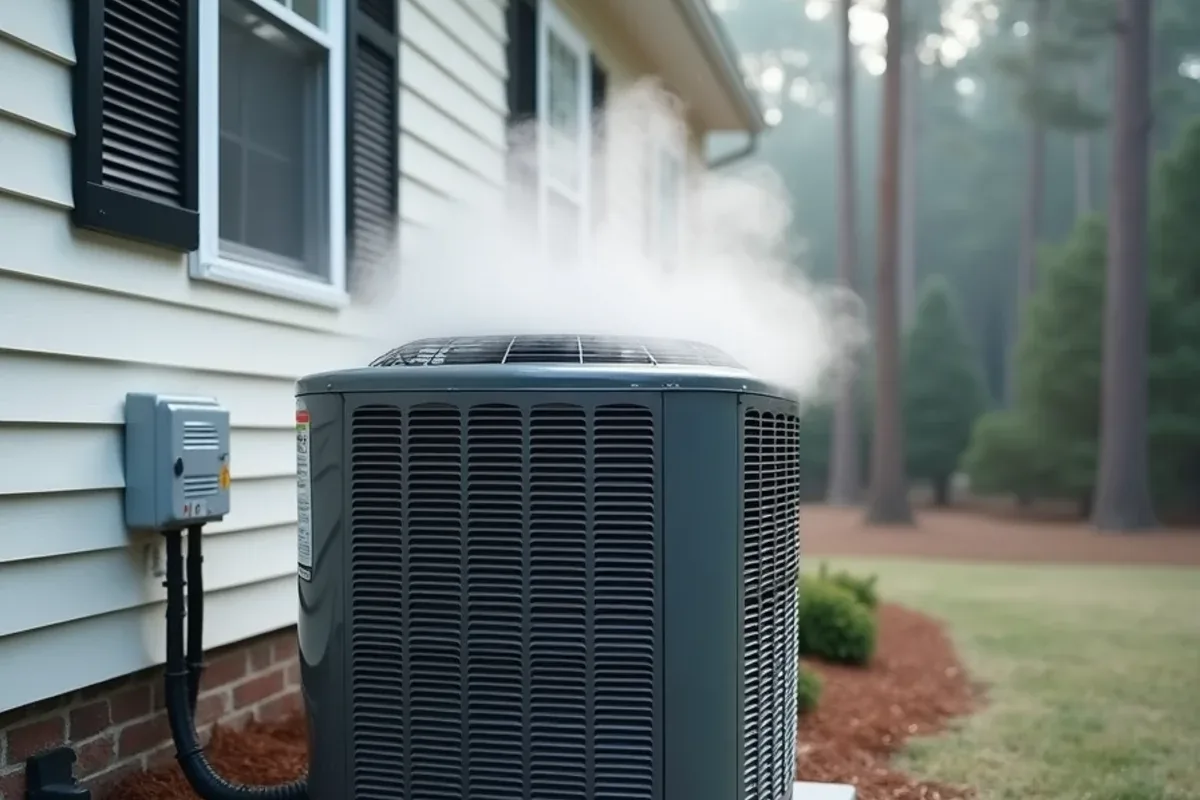
Defrost cycle (normal): when frost builds on the outdoor coil, the system reverses for a few minutes to melt it. The outdoor fan stops, you may hear a whoosh as the refrigerant changes direction, and steam rises off the unit. Indoors, the air can turn cool briefly unless the backup heat strips come on to temper it. Then the system switches back and normal heat returns, usually within a few minutes.
A real fault: cold air that lasts a long time, on every cycle, points to something else:
- A reversing valve stuck in cooling, or a burned-out solenoid coil on the valve, so the system cools the house in January.
- A failed defrost board or sensor that leaves the unit stuck in defrost, or never lets it defrost at all.
- Low refrigerant from a leak, which cuts heating capacity well before it stops the system.
- Backup heat that is not working, so the cool air during defrost is never tempered and the house falls behind on the coldest nights.
- Thermostat setup, such as a replacement thermostat configured for a furnace instead of a heat pump.
If the air stays cold for more than about 15 minutes at a stretch and the outdoor unit is not steaming, switch the thermostat to emergency heat to keep the house warm and call.
Iced-over outdoor unit: what is normal and what is not
A light white frost across the outdoor coil on a cold, damp morning is normal. Piedmont winters are humid, so frost forms readily when temperatures hover near freezing, and the defrost cycle clears it. Solid ice is a different story.
| What you see | Normal? | What to do |
|---|---|---|
| Thin frost that clears every so often with a burst of steam | Yes | Nothing; that is defrost working |
| Ice on the coil right after freezing rain or an ice storm | Expected at first | Give it a few defrost cycles; call if it does not clear |
| Solid ice covering the whole coil, fan blade iced in | No | Switch to emergency heat and call |
| Ice built up on the top of the unit or the fan grille | No | Often a gutter dripping on it; switch to emergency heat and call |
| Unit sitting in standing water or packed snow | No | Clear around the base if safe; the unit needs to drain freely |
Never chip or pry ice off the coil, and never pour hot water on it. The aluminum fins and copper tubing puncture easily, and a refrigerant leak turns a defrost problem into a far larger repair. Switch the thermostat to emergency heat and let the technician find out why defrost failed.
Around Matthews the usual reasons a heat pump ices solid are a failed defrost control or outdoor temperature sensor, a dead outdoor fan motor, low refrigerant, or a unit sitting so low that defrost water refreezes around its base. A gutter dripping onto the top of the unit is a common culprit on two-story homes where the outdoor unit sits under the roofline.
Auxiliary and emergency heat: why the electric bill jumps in a cold snap
Most heat pumps in Matthews have electric heat strips inside the indoor air handler. The thermostat uses them in two different ways, and the difference shows up on the Duke Energy bill.
| Question | Auxiliary heat (Aux) | Emergency heat (Em Heat) |
|---|---|---|
| Who turns it on | The thermostat, automatically | You, manually |
| When | During defrost, when the house is well below setpoint, or on the coldest nights | When the heat pump itself has failed or is iced solid |
| What runs | Heat pump plus heat strips | Heat strips only, or the furnace on a dual-fuel system; the outdoor unit is locked off |
| Operating cost | Higher than the heat pump alone, for short periods | Highest; meant as a stopgap until the repair |
Some aux heat is normal on a cold Piedmont night, or after you bump the thermostat up several degrees in the morning. Aux showing on the thermostat almost all the time, even in mild weather, is not. It usually means the heat pump is not carrying its share because of low charge, a weak compressor, a stuck reversing valve or a thermostat set up wrong, and the strips are quietly doing the work. Raising the setpoint a couple of degrees at a time also keeps the strips from kicking in when they are not needed.
Emergency heat is exactly what it sounds like: the outdoor unit has failed, so you lock it off and heat with the strips until it is fixed. It keeps the house warm, but the bill climbs fast, so call for the repair rather than living on it.
Reversing valves, defrost boards and low refrigerant charge
Three components cause most of the heat pump failures a cooling-only AC never has.
- Reversing valve. This four-way valve redirects refrigerant so the outdoor coil gives off heat in summer and absorbs it in winter. A solenoid coil on the valve shifts it on the thermostat’s signal, and when that coil burns out the system gets stuck in one mode. When the valve body itself sticks or leaks internally, heating and cooling both suffer. The technician tests coil voltage and the temperatures across the valve before calling for a new one, because replacing the valve body means brazing, evacuation and a fresh charge.
- Defrost board and sensors. The defrost control decides when defrost starts and stops, using a timer and a coil temperature sensor, plus more sensors on newer systems. A failed board or sensor can leave a unit icing over, or stuck in defrost and blowing cool air indoors. Power surges from summer thunderstorms and winter ice storms are hard on these boards.
- Refrigerant charge. A heat pump is sensitive to charge in both directions. A slow leak shows up first as weaker heat on cold nights and more aux heat, long before the system stops. The fix is to find and repair the leak, evacuate and weigh in the charge, work that requires EPA Section 608 certification.
The outdoor unit also has the same capacitors, contactors and condenser fan motors as an air conditioner, and they fail for the same reasons, so many summer AC repair calls in Matthews are really heat pump calls.
Heat pump short cycling or not starting at all
A heat pump that starts and stops every few minutes, or one that sits silent while the thermostat calls, is a different problem from a defrost cycle. During defrost the outdoor fan stops but the compressor keeps running and the cycle ends on its own in a few minutes. A unit that never starts, or keeps tripping off, needs a diagnosis.
| What you notice | Common causes |
|---|---|
| Runs a few minutes, shuts off, starts again | Oversized unit, thermostat near a supply register or in sun, low charge tripping a pressure switch, a clogged filter |
| Outdoor unit hums, fan does not spin (not during defrost) | Failed run capacitor, seized fan motor, debris in the blade |
| Outdoor unit completely silent, indoor blower runs | Tripped breaker or disconnect, failed contactor, no low-voltage signal from the thermostat or board |
| Starts, then trips the breaker | Shorted compressor or fan motor, failing capacitor, loose wiring at the disconnect |
Short cycling is more than an annoyance. Every start is the hardest moment for a compressor, and a heat pump that cycles all day in a humid Matthews summer leaves moisture in the house because it never runs long enough to dry the air. Our AC repair page covers the outdoor parts heat pumps share with air conditioners.
Ductless mini-split heat pumps
A ductless mini-split is a heat pump too, and it fails in its own ways: a clogged filter or blower wheel in the wall unit, a condensate line or pump that backs up and drips down the wall, a flashing error code from a sensor or board, or a leak at a flare fitting on the line set. Clean the washable filters monthly in pollen season, keep the outdoor unit clear and note the error code before you call. Bonus rooms and sunrooms are where most of them live around Matthews; see HVAC installation and replacement for when adding one makes sense.
Heat pump replacement and dual-fuel options for Matthews homes
When a heat pump past about 12 years old needs a compressor, a coil or a reversing valve on top of a leak, replacement deserves a serious look. New split heat pumps must meet the federal minimum of 14.3 SEER2 and 7.5 HSPF2, and new systems use lower-GWP refrigerants such as R-454B or R-32 instead of R-410A.
| Option | How it works | Good fit when |
|---|---|---|
| Heat pump with electric backup | Heat pump heats and cools; heat strips cover defrost and the coldest hours | The home has no gas service or is already all-electric |
| Dual fuel: heat pump with gas furnace | Heat pump runs on mild days; a gas furnace takes over below a set outdoor temperature | The home has Piedmont Natural Gas service and you want gas heat for the coldest nights |
| Variable-speed heat pump | The compressor adjusts its speed instead of running only full-on or off | Long, quiet runs for summer humidity control and steadier winter heat matter to you |
| Gas furnace with a new central AC | Separate heating and cooling equipment | You prefer gas heat and do not want a heat pump in winter |
Dual fuel suits Matthews well. Most winter hours here are mild enough for a heat pump to heat efficiently, and the gas furnace covers the handful of truly cold nights. The installer sets the switchover temperature for the house and the equipment, often somewhere in the 30s. If you already have a furnace, gas furnace repair explains what keeps that half of the system healthy.
Whatever the option, sizing should come from an ACCA Manual J load calculation, with equipment selected under Manual S and ducts checked against Manual D. An oversized heat pump short-cycles, leaves summer humidity behind and heats unevenly. HVAC installation and replacement covers how a replacement runs, including the Mecklenburg County mechanical permit and inspection in Matthews, and our guide to new HVAC system cost in the Charlotte area explains what drives the price and which utility rebates to ask about.
How long a heat pump lasts when it runs summer and winter
A gas furnace in Matthews runs a few months a year. A heat pump runs nearly all year: cooling from May into October, heating from November into March, and drying out the muggy shoulder weeks in between. That workload is why heat pumps here often last somewhere around 10 to 15 years, less with poor maintenance and more with good care, while a furnace in the same house may outlast two of them.
- Maintenance twice a year. A spring check before cooling season and a fall check before heating season catch weak capacitors, low charge and defrost problems early. The HVAC maintenance checklist for North Carolina homes lists what each visit should cover.
- Clean coils and filters. Pine pollen in spring and leaves in fall cut airflow across the coils, and a clogged filter makes the compressor work harder in both seasons.
- Correct charge. A system that runs low for a season or two wears out its compressor early.
- A good pad and clearance. A unit that sits level, above standing water, with open space around it and no gutter dripping on top lasts longer.
- Surge protection. Summer storms and winter ice storms knock power out across the area, and the restart surges are hard on boards and compressors.
Many heat pumps installed when Matthews subdivisions were built in the 1990s have already been replaced once, and the replacements from the mid-2000s are now at or past that range. If yours is in that group and the repairs are getting larger, our guide to repairing or replacing an older HVAC system helps frame the decision.
What every heat pump visit includes
- A live answer and honest timing before dispatch
- A check of thermostat mode and heat pump setup
- Readings in heating or cooling mode, not just a look at the unit
- Defrost control, reversing valve and heat strip checks
- A written price before any repair starts
- A replacement price for comparison when the system is near the end of its life
- A test run after the repair, with defrost checked in winter
What a heat pump repair visit looks like
- 1Call any hour. A live person answers (321) 478-0693, asks what the system is doing and what the thermostat shows, and gives you honest timing for the nearest available technician.
- 2Check the mode first. The technician confirms whether the system is in heat, cool, defrost or aux, and that the thermostat is set up for a heat pump.
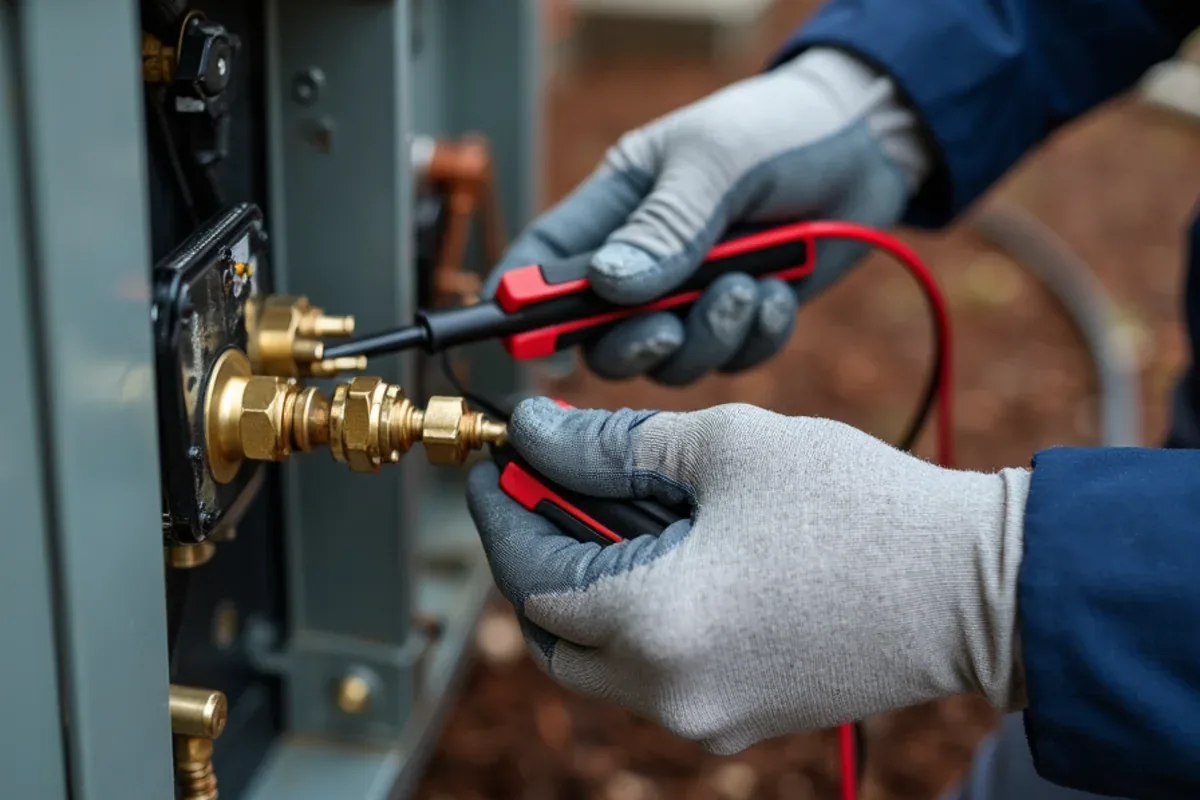
- 3Measure. Pressures and temperatures in heating or cooling mode, reversing valve operation, defrost board and sensor checks, outdoor fan and compressor amps, and heat strip amp draw.
- 4Written price. You hear what failed and get the repair price, plus a replacement price for comparison when the system is near the end of its life.
- 5Repair and test. After an approved repair, the system runs in heating and in cooling where outdoor conditions allow, and defrost is checked in winter.
Why choose Littleton Premier Heating & Air for heat pump repair and replacement
A live answer in any season
(321) 478-0693 is answered 24/7, through August heat waves and January cold snaps alike, with honest timing on every call.
Licensed and insured technicians
Every HVAC technician we send is licensed and insured in North Carolina. Refrigerant work is done by EPA Section 608 certified technicians, and any contractor can be checked on the board's license lookup at nclicensing.org.
Normal or broken, explained plainly
You find out whether the heat pump was just defrosting or has a real fault before anyone talks about parts.
Repair and replacement side by side
When a 15-year-old heat pump needs a major part, you see the repair price and the replacement options together and decide.
What affects heat pump repair and replacement cost
A heat pump repair can be a capacitor or a compressor, and a replacement can be a straight swap or a new dual-fuel system with duct changes. The technician diagnoses first and puts any price in writing before work starts. These are the main factors.
- The failed part. Capacitors, contactors and defrost sensors are smaller repairs; reversing valves, compressors and coils are the large ones.
- Refrigerant work. Any repair that opens the sealed system adds recovery, evacuation and a weighed-in charge, and R-22 or R-410A availability affects it.
- Heat strips and controls. Replacing elements or sequencers, or correcting a thermostat set up for the wrong system, adds scope.
- Replacement type. A heat pump with electric backup, a dual-fuel system and a variable-speed system differ widely in equipment and labor.
- Matching the indoor unit. A new outdoor unit on a newer refrigerant usually needs a matched indoor coil or air handler.
- Ductwork and electrical. Undersized or leaking ducts, or electrical service that needs updating, add to a replacement.
- Permits and rebates. A replacement in Matthews needs a Mecklenburg County mechanical permit; check the current Duke Energy and Piedmont Natural Gas program pages for rebates before you buy.
- Timing. Any after-hours rate is stated on the call before dispatch.
We don't publish prices we can't stand behind: you hear the price for your system, from the technician who diagnosed it, before any work starts. More detail: New HVAC System Cost in the Charlotte Area: What Drives the Price and Which Rebates to Ask About
Heat Pump Repair and Replacement around Matthews, NC
Heat pump calls come from all over Matthews, with the heaviest share from 1990s and 2000s subdivisions where the original or second heat pump is reaching the end of its run. Across the county line, builder-grade units from the 1995 to 2010 boom keep heat pump repair in Indian Trail busy, alongside heat pump service in Stallings and the mix of heat pumps and dual-fuel systems behind requests for heat pump and dual-fuel repair in Mint Hill. Every town we serve is on the HVAC service areas page.